

On July 4, 2026, Pastor Ezra Jin Mingri walked out of a Chinese detention center after nearly nine months. His crime was leading online worship for Beijing's Zion Church, one of the largest unregistered Protestant congregations in the country. Weeks later, the U.S. government added 43 more Chinese companies to its forced labor import ban, the largest single expansion in the law's history.
The same government that detained Pastor Jin controls some of the largest companies in the world, and many of them sit quietly inside the index funds that American Christians own. This article explains why China falls under Inspire Insight's State Owned Enterprise screen, what the record shows, and what believers should weigh before investing there.
Inspire Insight flags a company under the State Owned Enterprise category when it is "owned and/or controlled by a Nation State/government of a country excluded from investment due to significant human rights violations."
The screen draws on U.S. Department of State findings in four areas:
Ownership is not the only trigger. A company is also flagged when the State holds a majority share (50% or more) of a State or a State-controlled agency. Ten countries currently fall under this screen: China, Saudi Arabia, United Arab Emirates, Qatar, Kuwait, Russia, Iran, Pakistan, Malaysia and Vietnam (list can be found at https://inspireinsight.com/excludedcountries).
China meets more than one of the State Department's criteria at once:
Either finding alone would place China on the list. The scale of its state sector makes the screen matter more for China than for any other country. China's central government oversees roughly 100 central SOEs through the State-owned Assets Supervision and Administration Commission (SASAC) and carries a complex parent/subordinate relationship with many companies housed within each other, and since 2016 the Communist Party has required SOEs to write the Party's leadership role into their corporate charters.
For a company under this screen, the question is not whether it makes a sinful product. The question is whether an investor's capital flows to a government that persecutes the Church and uses forced labor.
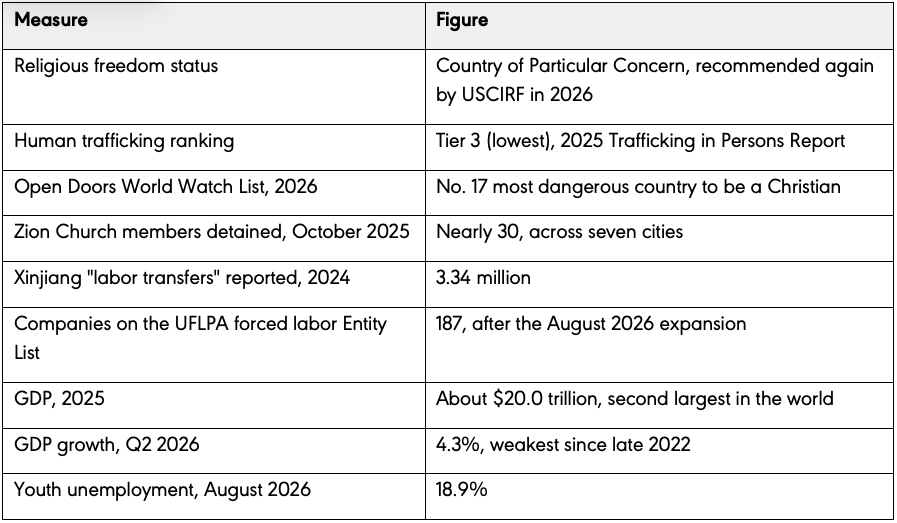
The U.S. government's own findings place China among the worst violators of religious freedom and the worst human traffickers in the world. The record below is drawn from U.S. government reports and independent human rights groups.
The State Department's 2025 Trafficking in Persons Report kept China at Tier 3. It found "a government policy or pattern of widespread forced labor in government-affiliated sectors." Key findings:
The U.S. response is growing. On July 31, 2026, the Department of Homeland Security added 43 companies to the Uyghur Forced Labor Prevention Act (UFLPA) Entity List, its largest single expansion. That brought the list to 187 entities across aluminum, cotton, apparel, pharmaceuticals, battery materials and other sectors. Goods tied to those companies are presumed made with forced labor and are detained at U.S. ports.
The U.S. Commission on International Religious Freedom's 2026 Annual Report again recommended China be designated a Country of Particular Concern for "systematic, ongoing, and egregious" violations. Under Xi Jinping's "Sinicization of religion" policy, every faith must conform to Communist Party ideology.
On February 9, 2026, Hong Kong media founder Jimmy Lai was sentenced to 20 years under the Beijing-imposed National Security Law, the harshest sentence yet under that law. Lai, a Catholic, was convicted of collusion with foreign forces and of publishing seditious material. His case shows how far the rule of law has eroded in what was once Asia's most open financial center.
The abuses described above are not new. Since the People's Republic was founded in 1949, the Communist Party has treated independent faith and dissent as threats to its rule. The methods have changed over time, from open destruction to legal control to digital surveillance, but the goal has stayed the same: no loyalty may rival loyalty to the Party.
After taking power, the Party expelled foreign missionaries and forced Protestants into the state-run Three-Self Patriotic Movement, formally established in 1954. Catholics were placed under a state-run patriotic association that cut ties to Rome. Believers who refused to register, such as Watchman Nee and Wang Mingdao, spent decades in prison. China's army entered Tibet in 1950, and after a failed uprising in 1959 the Dalai Lama fled to India.
During the Cultural Revolution (1966–1976), the state tried to abolish religion entirely. Churches, temples and mosques were closed or destroyed, Bibles were burned, and believers were beaten, imprisoned or killed. Yet the church survived underground in homes, the beginning of today's house church movement.
Under Deng Xiaoping's reforms, the Party's Document 19 of 1982 allowed limited worship, but only in state-registered venues. Unregistered house churches remained illegal and grew rapidly anyway. Openness had firm limits: on June 4, 1989, the army crushed the pro-democracy protests in Tiananmen Square, killing hundreds and possibly thousands. In 1995, six-year-old Gedhun Choekyi Nyima, named the Panchen Lama by the Dalai Lama, disappeared into state custody and has not been seen since. In July 1999, Beijing banned the Falun Gong spiritual movement and began a campaign of detention and torture against its followers. That same year, the U.S. first named China a Country of Particular Concern.
Since Xi Jinping took power in 2012, persecution has intensified and become more systematic. Between 2014 and 2016, authorities in Zhejiang province tore down an estimated 1,700 to 2,000 church crosses. Revised Regulations on Religious Affairs took effect on February 1, 2018, requiring every religious group to register and closing house churches across the country. In December 2018, police raided Chengdu's Early Rain Covenant Church, and Pastor Wang Yi was later sentenced to nine years for "inciting subversion of state power."
In Xinjiang, mass detention of Uyghurs and other Muslim minorities began around 2017. On January 19, 2021, the U.S. State Department determined that China was committing genocide and crimes against humanity there. In Hong Kong, the National Security Law imposed on June 30, 2020, ended the city's protected freedoms of speech, press and assembly. Those threads lead directly to the present day: the 2025 Zion Church crackdown, the 2026 sentencing of Jimmy Lai and the forced labor findings described above.

China is the world's second-largest economy, but its growth is slowing and its households are not spending. Officially, GDP grew 5.0% in 2025 to 140.19 trillion yuan, about $20.0 trillion. Beijing lowered its 2026 target to 4.5–5%.
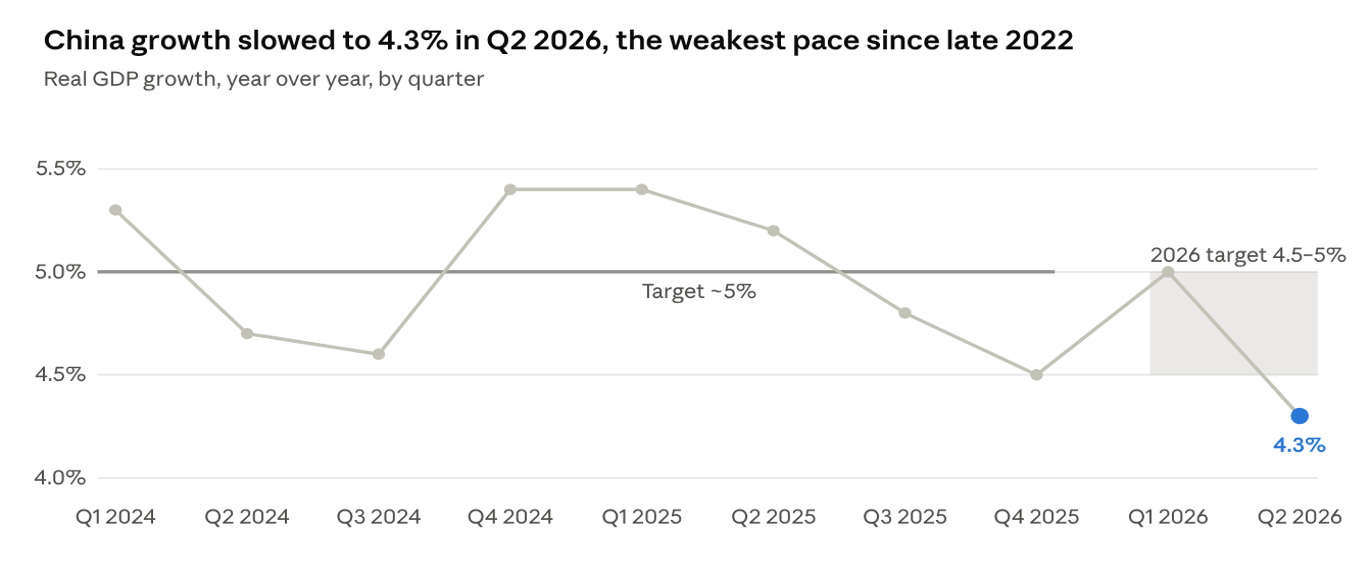
Second-quarter growth of 4.3% fell below that target range, and first-half growth averaged 4.7%.28 Investors should treat official Chinese statistics with caution, since independent estimates have long suggested reported growth runs higher than reality.
Exports grew about 19.5% from January through August 2026, led by AI-related hardware and advanced manufacturing. Beijing is directing state capital toward semiconductors, robotics, electric vehicles and batteries, sectors where state-owned and state-backed firms are central.
The U.S.–China trade truce first reached in November 2025 was extended to January 10, 2027 after Xi Jinping met President Trump in Washington in September 2026. The two sides also agreed to reciprocal tariff cuts on about $30 billion of goods each way. The truce lowers near-term risk, but tariffs, export controls and forced labor import bans remain in place, and the relationship can shift quickly.
Most American investors never buy a Chinese state-owned company on purpose. They own one through an emerging markets fund, an international index fund or a target-date fund. China is one of the largest country weights in the MSCI Emerging Markets Index, and state-owned companies make up close to half of China's domestic A-share market, concentrated in banking, energy, utilities and telecom (Allianz Global Investors).
The table below shows the kinds of household-name Chinese SOEs that commonly appear in broad international funds. It is illustrative, not a complete list of flagged holdings; investors should check current Inspire Insight results for any specific security.
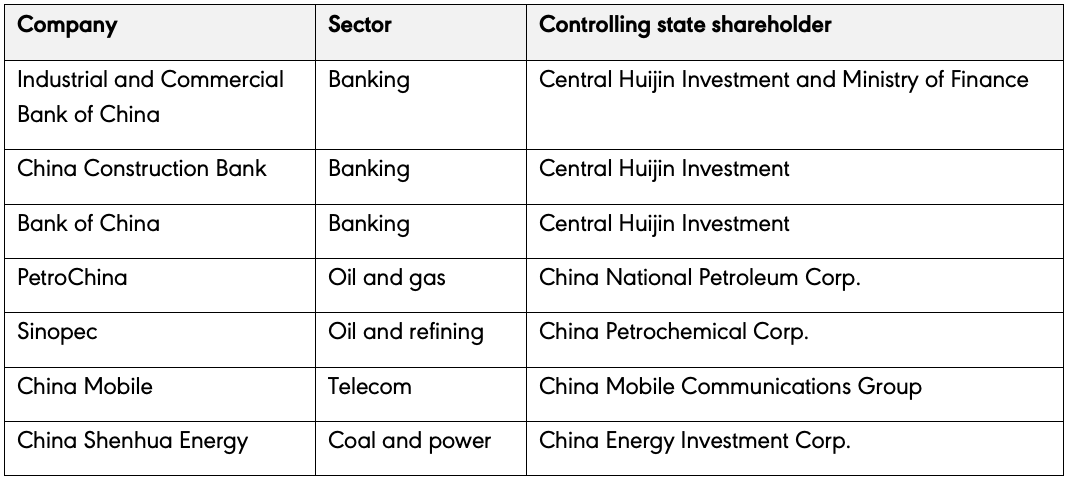
These measures mean Washington already treats many Chinese state-linked firms as security risks. Inspire's screen goes further and asks a moral question: whether a believer's capital should help finance a government that persecutes the Church.
Scripture does not let believers treat persecution abroad as a distant headline. "Remember those in prison as if you were together with them in prison, and those who are mistreated as if you yourselves were suffering" (Hebrews 13:3). "If one part suffers, every part suffers with it" (1 Corinthians 12:26). The pastors of Zion Church and the members of unregistered house churches across China are part of that body. Investing in the state that detains them is not a neutral act.
The prophets condemned rulers who profited from coerced work: "Woe to him who builds his palace by unrighteousness ... making his own people work for nothing, not paying them for their labor" (Jeremiah 22:13). The State Department's finding of state-imposed forced labor goes to the heart of how wealth is created, which is why China's Tier 3 ranking alone places it under Inspire's screen.
Inspire often favors engaging companies to change their behavior. With a state-owned enterprise, that tool is weak. The controlling shareholder is the government, and since 2016 Party committees have been written into SOE charters. A minority investor's vote cannot outweigh the State. For SOEs from excluded countries, avoidance is often the most direct way to keep capital from supporting the regime. Additionally, continual prayer and even funding missions work to China are the best things that Christian investors can do to hopefully see change on a national level.
Biblically responsible investing is also prudent investing. Chinese SOEs carry risks that investors in U.S. companies rarely face:
Because Chinese SOEs sit inside broad index funds, many Christian investors hold them without knowing it. Investors can run their funds and portfolios through Inspire Insight to see which holdings are flagged under the State Owned Enterprise category, then talk with a financial advisor about biblically aligned alternatives for international and emerging markets exposure.40
Stewardship goes beyond portfolios. Believers can pray for the church in China by name, follow the cases of detained pastors through groups like Open Doors, The Voice of the Martyrs and ChinaAid, and encourage elected officials to keep religious freedom central in U.S.–China relations (these groups are not affiliated with Inspire Investing, but simply mentioned for awareness purposes).
China is on Inspire's State Owned Enterprise list because the U.S. government's own findings show it persecutes people of faith and runs state-imposed forced labor. Its economy is large but slowing, weighed down by a property collapse, weak consumers and rising youth unemployment. Its largest companies answer to the Communist Party, sometimes through majority ownership and sometimes through a golden share.
For the Christian investor, the issue is not whether China can be profitable. It is whether capital entrusted by God should strengthen a government that abuses the basic dignity of those who carry the image of God.
"Speak up for those who cannot speak for themselves, for the rights of all who are destitute. Speak up and judge fairly; defend the rights of the poor and needy." — Proverbs 31:8–9 (NIV)
Bringing ten years of experience as a professor at a Christian college, Chris is deeply rooted in faith-based values. He excels as a faith-based writer, adept at crafting financial curriculum with spiritual depth. In his role, Chris is responsible for sourcing and evaluating reliable sources to accurately screen companies and assign them an Inspire Impact Score. Furthermore, he meticulously curates screening categories to maintain clarity and alignment with Inspire's faith-based mission.


 (877) 859-6383inspire@inspireadvisors.com



Information on this website does not involve the rendering of personalized investment advice but is limited to the dissemination of general information on products and services. A professional adviser should be consulted before implementing any of the options presented. The information presented is believed to be factual and up-to-date, but we do not guarantee its accuracy and it should not be regarded as a complete analysis of the subjects discussed.
The firm only transacts business in states where it is properly registered or is excluded or exempted from registration requirements. Registration as an investment advisor does not constitute an endorsement of the firm by securities regulators nor does it indicate that the advisor has attained a particular level of skill or ability.
Different types of investment involve varying degrees of risk, and there can be no assurance that any specific investment will either be suitable or profitable for a client's investment portfolio. No client or prospective client should assume that any information presented and/or made available on this Website serves as the receipt of, or a substitute for, personalized individual advice from the adviser or any other investment professional.
National Admin Office: 3597 E Monarch Sky Ln, Suite 330 Meridian, ID 83646; Phone: (877) 859-6383 Investment advisory services offered through Inspire Advisors, LLC, a Registered Investment Advisor registered with the SEC.
© Copyright - Inspire Advisors, LLC

